
Press safety and automatic feeding
We make your eccentric and mechanical presses safe and automatic. We design light curtains, clutch-to-brake conversion, guard fencing and interlocked door solutions together with servo NC feeding systems, and carry out the conversions in our own mechanical workshop in Ankara. Sales and quotes from Ankara-based AOM, nationwide across Turkey.
- Type 4 (IEC 61496) safety light curtain
- Stopping time and safety distance measured per EN ISO 13855
- EN ISO 16092-2 mechanical press safety requirements
- Servo NC feeding, 0–500 mm material width, 10 µm (0.01 mm) step accuracy
What we do
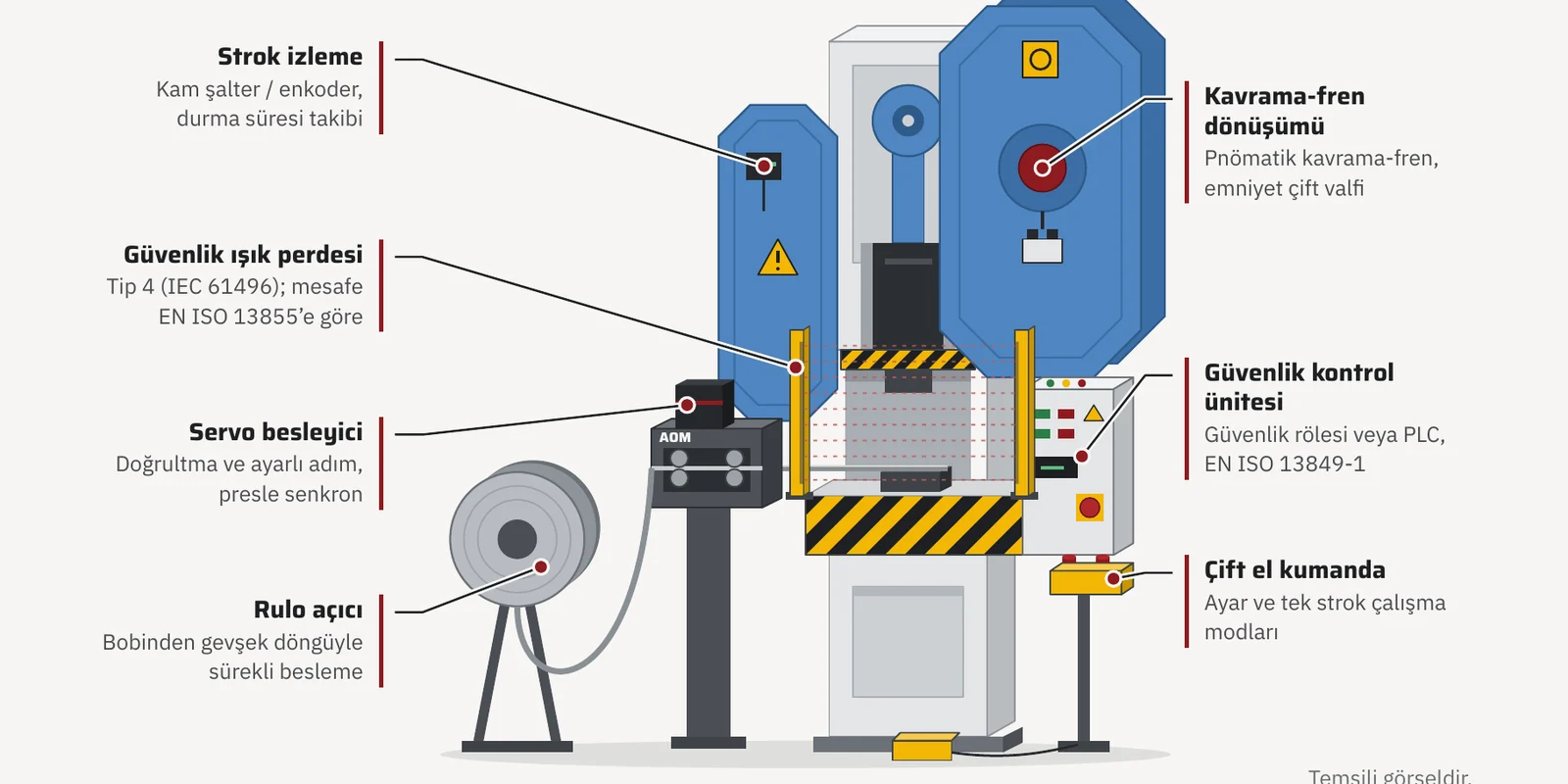
Type 4 (IEC 61496) light curtain for presses that can stop mid-stroke; distance calculated per EN ISO 13855.
Pneumatic clutch-to-brake conversion (with a dual safety valve) on mechanical presses, followed by a light curtain; used in fast, hand-fed production.
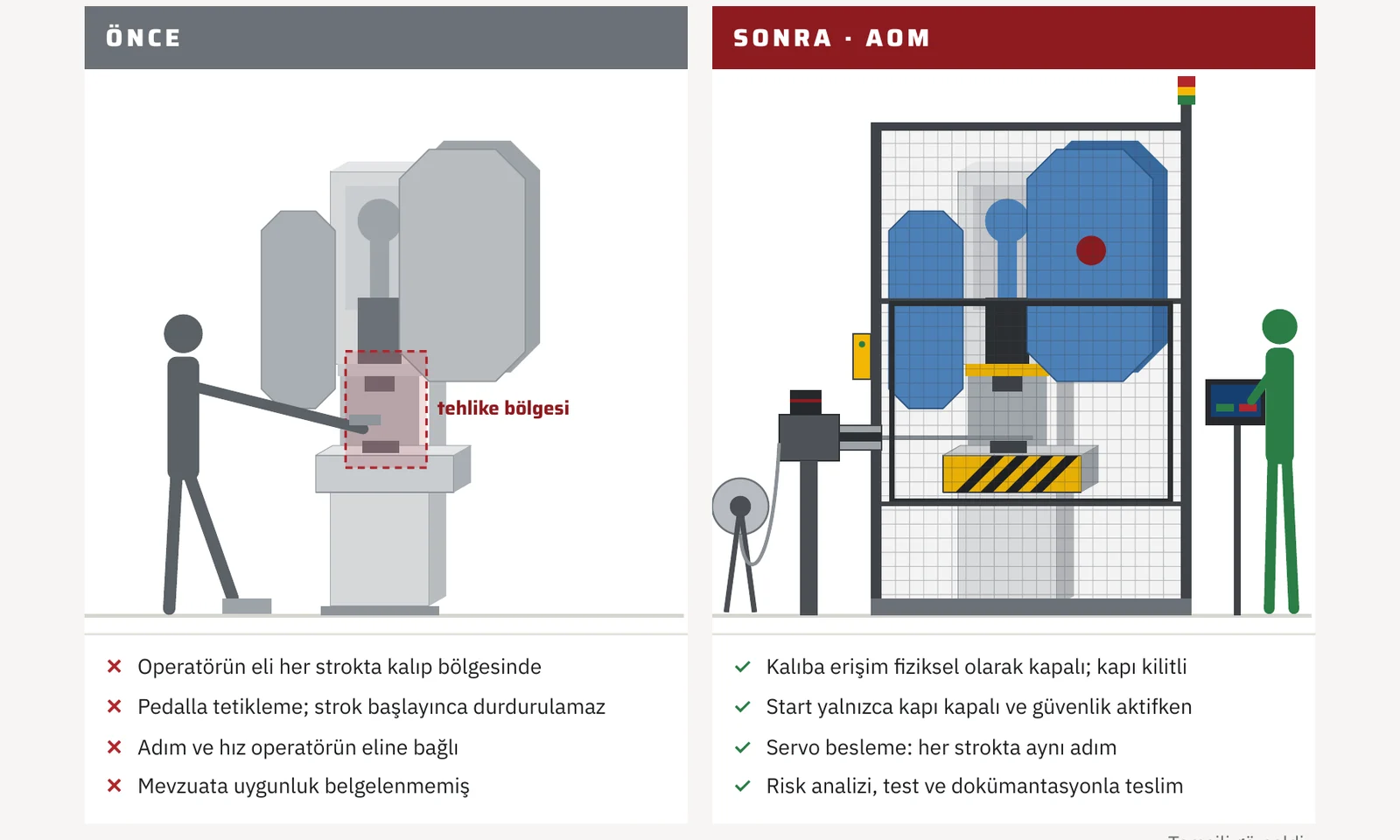
Perimeter fencing and an interlocked sliding door on automatically fed mechanical presses; physically blocks access to the die.
Interlocked door and single-stroke mechanism on hand-fed mechanical presses; the stroke cannot start until the door is closed.
A line of a decoiler, straightener and servo NC feeder; feeding only happens while the die is open, and the press and feeder run on the same crank angle. 0–500 mm material width, 10 µm step accuracy.
Safety relay or safety PLC (EN ISO 13849-1), emergency stop, mode selection and stroke-monitoring circuit; guards and panels are built in our own workshop and installed on site.
Periodic measurement of stopping time, safety function tests, periodic inspection support, spare parts and valve/contactor lifetime tracking (by cycle count).
Same press, a different workplace
You don't need to replace your press. AOM adds a safety system and automatic feeding to your existing eccentric press; the operator moves away from the die and to the control panel.
Servo NC feeding: the same step on every stroke
The servo NC feeding line takes the strip from the decoiler, straightens it, and feeds it into the die by the step length entered on the HMI on every stroke. Feeding only happens while the die is open; the press and feeder run on the same crank angle.

Standards framework
Press safety is defined by legal regulations, international Type A, B and C standards, and national rules. AOM designs, implements and documents its guarding solutions within this framework.
| Type A · fundamental | ISO 12100 risk assessment and risk reduction |
|---|---|
| Type B · safety-related | ISO 13849-1 · IEC 62061 safety functions · ISO 13855 safety distance · ISO 13857 access · ISO 14119 interlocking · ISO 14120 guards · ISO 13851 two-hand control · ISO 13850 emergency stop · IEC 61496 light curtain |
| Type C · press-specific | EN ISO 16092-1 general · EN ISO 16092-2 mechanical presses |
| Regulation (TR/EU) | Machinery Safety Directive (2006/42/EC) · Use of Work Equipment Directive (2009/104/EC) |
Seven steps, one point of contact
Every project starts with a simulation that verifies reach, collision and cycle time.
- 01Needs and part analysis
- 02Pre-project simulation
- 03Mechanical design
- 04Manufacturing and assembly, in our own workshop
- 05Electrical and control
- 06Calibration and programming
- 07Commissioning and training
Who we've worked with
We don't share a specific case study, as project details are covered by confidentiality agreements; you can see our main references on the home page.
Frequently asked questions
On full-revolution mechanical presses, a light curtain alone is not considered sufficient protection; AOM applies the light curtain together with a pneumatic clutch-to-brake conversion first (Solution B), or installs an interlocked door with a single-stroke mechanism (Solution D).
It handles 0–500 mm material width at 10 µm (0.01 mm) step accuracy; feeding only happens while the die is open and advances in sync with the press.
AOM is not a notified body and does not issue an official conformity certificate. We carry out the project with an ISO 12100 risk assessment, stopping time and safety distance measurement per EN ISO 13855, and safety function tests; we deliver with a commissioning report, instructions for use and test records. The legally required periodic inspections specified in the regulation are carried out by an authorized inspection body, with AOM's support.
Protection is determined not by tonnage but by clutch type, feeding method, stopping time, bed size and number of operators. We apply a suitable solution within the same standards framework for every class, from small (e.g. ≤40 t) to large tonnage (e.g. >160 t); the final choice is made with an on-site risk analysis and stopping-time measurement.
Send us your press's tonnage, clutch type and feeding method; we'll work out the right solution together.
info@aomtechnology.tr+90 544 624 75 14